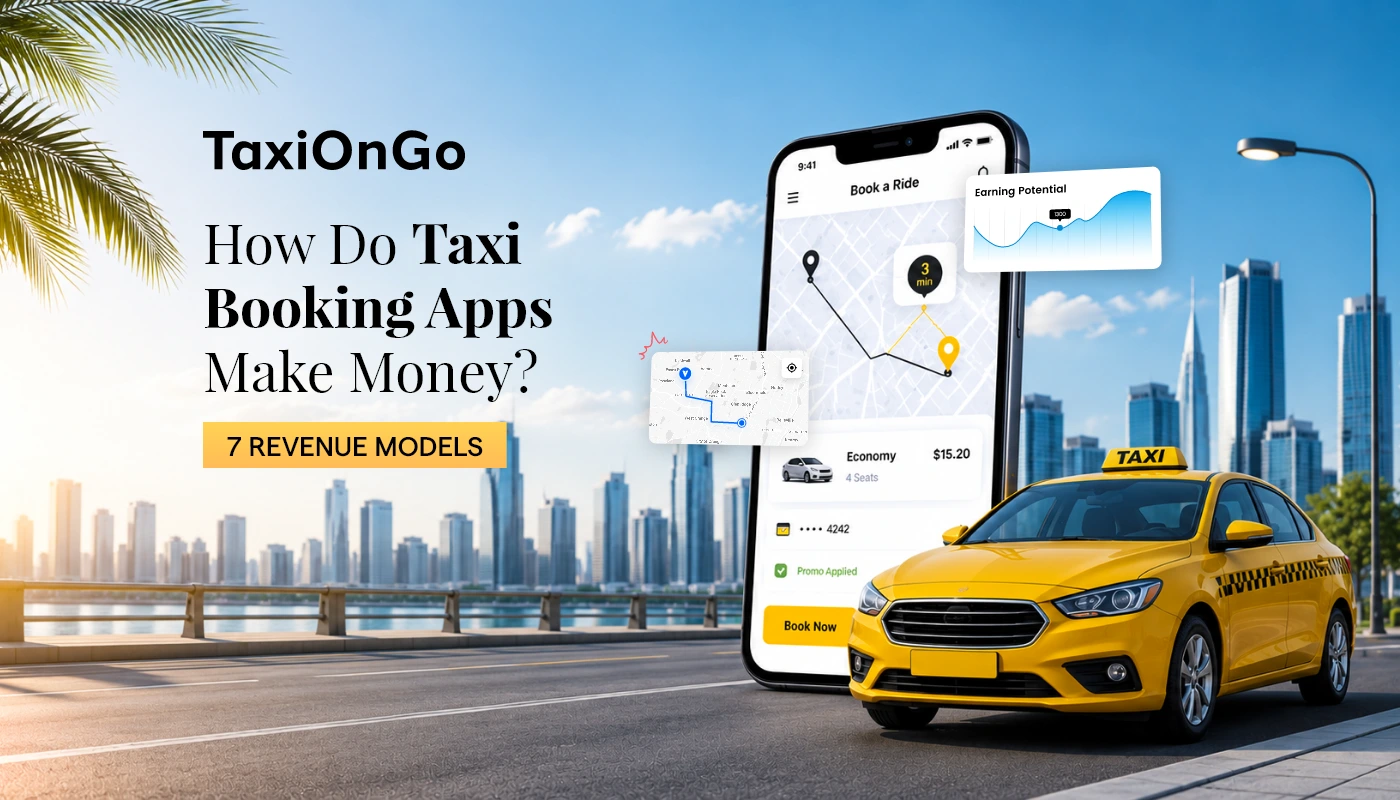
How Taxi Booking Apps Generate Revenue: 7 Proven Business Models
A taxi booking app can earn revenue through ride commissions, driver subscriptions, booking fees, dynamic pricing, advertising, corporate transport contracts and additional mobility services. The right model depends on who owns the vehicles, how drivers are engaged, local transport regulations and the number of completed bookings.
Some platforms use one primary revenue stream, while others combine several models. For example, commission-based marketplaces earn from each completed trip, while subscription-led platforms charge drivers a fixed daily, weekly or monthly access fee. In India, Uber moved its autorickshaw service to a subscription model in 2025, showing that revenue structures can change by vehicle category and market conditions.
Key Takeaways:
- Taxi apps commonly earn through commissions, subscriptions, booking charges and corporate contracts.
- A commission model generates revenue whenever a driver completes a paid trip.
- A subscription model provides more predictable platform income but may be less attractive to low-volume drivers.
- Revenue does not equal profit. Driver incentives, payment fees, support, marketing and technology costs must be deducted.
- TaxiOnGo provides branded rider, driver and admin applications with booking, payment, GPS tracking and fleet-management capabilities.
How Do Taxi Apps Make Money?
Taxi apps make money by charging passengers, drivers, fleet operators or business clients for using their technology and transportation network.
The platform may retain a percentage of every fare, charge drivers for platform access, add a passenger booking fee or provide transport services under corporate contracts. A larger taxi app business may use several revenue sources to reduce its dependence on passenger commissions.
The seven most widely used taxi app business models are explained below.
1. Commission on Every Completed Ride
Under the commission model, the platform keeps an agreed percentage of the trip value and transfers the remaining amount to the driver or fleet operator.
For example, consider the following illustrative calculation:
- Passenger fare: $20
- Platform commission: 20%
- Platform revenue: $20 × 20% = $4
- Driver or fleet share before other deductions: $16
The 20% figure is only an example, not a universal industry rate. Actual service fees can vary by company, city, vehicle category, driver agreement and trip. Uber’s official Indian business documentation distinguishes the driver-provided transportation fare from Uber’s separate service fee.
This model works well when the platform has a steady volume of completed rides. However, operators must keep commissions competitive enough to retain drivers.
2. Driver Subscription and Membership Fees
A subscription-based taxi business model charges drivers a fixed amount for accessing booking requests, dispatch technology and other platform features.
The fee may be collected:
- Daily
- Weekly
- Monthly
- By service area
- By vehicle category
This model gives drivers greater clarity because they know the access cost in advance. It can also produce predictable recurring revenue for the platform.
A hybrid approach can also be used. For example, the app may offer a basic subscription with a low ride commission and a premium plan with advanced reports or priority bookings.
3. Passenger Booking and Convenience Fees
A taxi booking app can add a fixed or variable booking charge to the passenger’s fare.
Suppose the ride fare is $15 and the app adds a $1 booking fee. The platform receives $1 in booking-fee revenue, while the treatment of the remaining $15 depends on its driver and fleet agreement.
A fee may cover services such as:
- Digital booking
- Driver matching
- Customer support
- Cashless payment processing
- Scheduled ride management
- Electronic receipts
The fee must be displayed clearly before confirmation. Taxes, fare-disclosure rules and permitted charges differ across jurisdictions, so the final structure should be reviewed for each launch market.
4. Dynamic and Peak-Demand Pricing
Dynamic pricing changes the fare when passenger demand and available driver supply are unbalanced. The platform may earn more per booking during busy periods, provided the pricing structure is permitted and communicated transparently.
Higher rates may apply during:
- Airport rush periods
- Major events
- Severe weather
- Late-night hours
- Public holidays
- Temporary driver shortages
Dynamic pricing should not be treated as automatic profit. Higher fares may require greater driver payouts, and excessive increases can reduce bookings or damage customer trust.
Taxi businesses can also use simpler pricing variations, such as airport packages, night charges, waiting fees, fixed zones and advance-booking rates.
5. Corporate and Contract-Based Transportation
Corporate transport can create recurring revenue by serving businesses rather than relying entirely on individual passengers.
A taxi company may provide:
- Employee transportation
- Airport transfers
- Hotel guest travel
- Hospital transportation
- School or university mobility
- Event transportation
- Monthly executive travel
The company may charge per trip, per passenger, per vehicle, per route or under a monthly service agreement.
An online cab booking app can support corporate accounts through centralized billing, ride histories, scheduled bookings and electronic receipts. TaxiOnGo, for example, includes scheduled booking, multiple payment options, trip history, automated receipts and an admin panel for operational control.
Corporate contracts may provide steadier demand, but profitability still depends on vehicle use, route length, waiting time, driver cost and payment terms.
6. Advertising and Promotional Partnerships
A taxi app can generate secondary revenue by offering controlled advertising opportunities to relevant businesses.
Possible formats include:
- Sponsored offers inside the rider app
- Featured hotels, restaurants or events
- In-app discount partnerships
- Branded airport campaigns
- Local business promotions
- Vehicle-screen or receipt advertising
For example, a hotel may pay to appear as a recommended destination or offer an exclusive ride discount to app users.
Advertising should remain secondary to the booking experience. Too many promotional messages can make the app difficult to use and may reduce customer trust. Operators must also obtain appropriate consent before using personal or location data for targeted promotions.
7. Additional Services and Marketplace Expansion
A taxi app business can increase revenue by offering services beyond standard passenger rides.
Potential extensions include:
- Parcel and document delivery
- Airport transfers
- Rental cars
- Hourly vehicle bookings
- Chauffeur services
- Medical transportation
- Accessible vehicles
- Electric vehicle categories
- Intercity travel
- Roadside assistance
TaxiOnGo states that a white-label platform can be adapted for scheduled rides, package delivery and additional fleet categories without requiring a completely separate application.
The best additional service is usually one that can use the company’s existing drivers, vehicles, dispatch team and customer base. Adding an unrelated service may increase operational complexity without improving margins.
How Much Does It Cost to Develop a Taxi Booking App?
Taxi booking app development costs vary according to the number of applications, feature scope, technology architecture, integrations and customization requirements.
Clutch’s August 2026 pricing guide reports that most mobile app projects reviewed on its platform fall between $10,000 and $49,999, while its calculated average is about $90,780. Clutch also identifies features, user-experience complexity and backend development as major cost variables. These are general mobile-app figures, not taxi-app quotations.
A complete custom taxi platform may require:
- Rider application
- Driver application
- Admin and dispatch panel
- GPS and mapping
- Payment integration
- Fare calculation
- Notifications
- Driver verification
- Analytics
- Testing, deployment and maintenance
A white label taxi app solution generally starts from an existing platform and is adapted with the operator’s branding, pricing and required functionality. TaxiOnGo describes its platform as a branded iOS and Android solution that includes rider, driver and admin applications.
A credible estimate should state what is included, excluded and assumed. Without a defined scope, we cannot confirm an accurate development cost.
How Profitable Is a Taxi Business?
A taxi business is profitable when the revenue earned from completed trips and additional services exceeds driver, vehicle, technology, marketing, payment and administrative costs.
A simple profit calculation is:
Operating profit = Total revenue − Total operating expenses
Assume an app completes 10,000 monthly trips and earns an average platform fee of $2 per trip:
10,000 × $2 = $20,000 monthly platform revenue
If monthly platform expenses are $15,000:
$20,000 − $15,000 = $5,000 operating profit
This is an illustrative calculation, not an industry forecast. Actual profitability depends on booking volume, customer-acquisition cost, driver incentives, cancellations, local fares, taxes and fleet ownership.
How to Develop a Taxi Booking App
Developing a taxi booking app requires clear business rules before technical development begins.
Start with these steps:
- Choose the operating model: Decide whether you will own vehicles, onboard independent drivers or support external fleets.
- Select a revenue model: Define commissions, subscriptions, passenger fees or corporate billing.
- Document user journeys: Map booking, driver acceptance, tracking, payment, cancellation and support processes.
- Define essential features: Prioritize the rider app, driver app, dispatch panel and admin controls.
- Select custom or white-label development: Compare ownership, customization, launch time and long-term costs.
- Test the complete booking flow: Validate fares, maps, notifications, payments and driver allocation.
- Launch in a controlled area: Measure demand, trip completion, driver availability and customer retention before expanding.
How To Start Your Taxi Business?
Start a taxi business by defining the service area, customer segment, vehicle model, legal requirements, pricing and booking process.
Before launch, confirm:
- Business and transport licences
- Driver eligibility requirements
- Vehicle and insurance rules
- Local fare regulations
- Tax responsibilities
- Payment methods
- Customer support procedures
- Driver onboarding and safety checks
These requirements differ by jurisdiction. A local legal or transport adviser should verify the obligations for the intended city or country.
A white label taxi app can reduce the amount of software that must be created from the beginning. TaxiOnGo provides brand customization, multi-language and multi-currency support, dispatch functions, GPS tracking, scheduled bookings and multiple payment options.
Frequently Asked Question
Taxi booking apps earn through ride commissions, driver subscriptions, passenger booking fees, corporate transport agreements, advertising and additional services. The selected structure should reflect local regulations, driver expectations and the operator’s costs.
Commission and subscription models are the most direct options. Commission works well when trip volume is strong, while subscriptions can provide predictable recurring income. Many operators combine one primary model with corporate accounts or additional mobility services.
Revenue depends on completed bookings, average platform income per trip and recurring fees. For example, 5,000 monthly trips earning $2 each would generate $10,000 before expenses. Actual earnings without booking, pricing and cost data cannot be confirmed.
Uber charges service fees in some markets, but its exact fee structure can vary. In India, it replaced commission with subscriptions for autorickshaw drivers in 2025. Therefore, a single universal Uber commission rate cannot be confirmed.
Taxi businesses can increase revenue by reducing missed bookings, improving dispatch, offering scheduled rides, adding corporate accounts and introducing relevant services such as airport transfers or deliveries. Real-time tracking and admin controls also help operators manage vehicles and trips more efficiently.
Recent Blogs
Taxi businesses can lose a significant portion of potential revenue when they rely on manual booking methods instead of digital booking systems. Missed calls, delayed dispatching, inefficient fleet utilization, and poor customer experiences often result in lost bookings and lower driver productivity. A modern taxi booking app helps eliminate these inefficiencies by automating ride requests, […] Read more

Fleet businesses planning to digitize their operations face an important decision- should they build custom taxi software from scratch or purchase a ready-made platform? Building offers greater control over the product, technology and user experience. Buying white label taxi software, however, usually provides faster deployment, a lower initial investment and access to essential features that […] Read more

The ride-hailing industry has reshaped urban mobility across the globe, giving entrepreneurs and fleet operators two distinct paths to build a profitable taxi business. You can either join an established aggregator platform think Uber or Ola or invest in your own white-label taxi app solution tailored to your brand and market. On the surface, the […] Read more