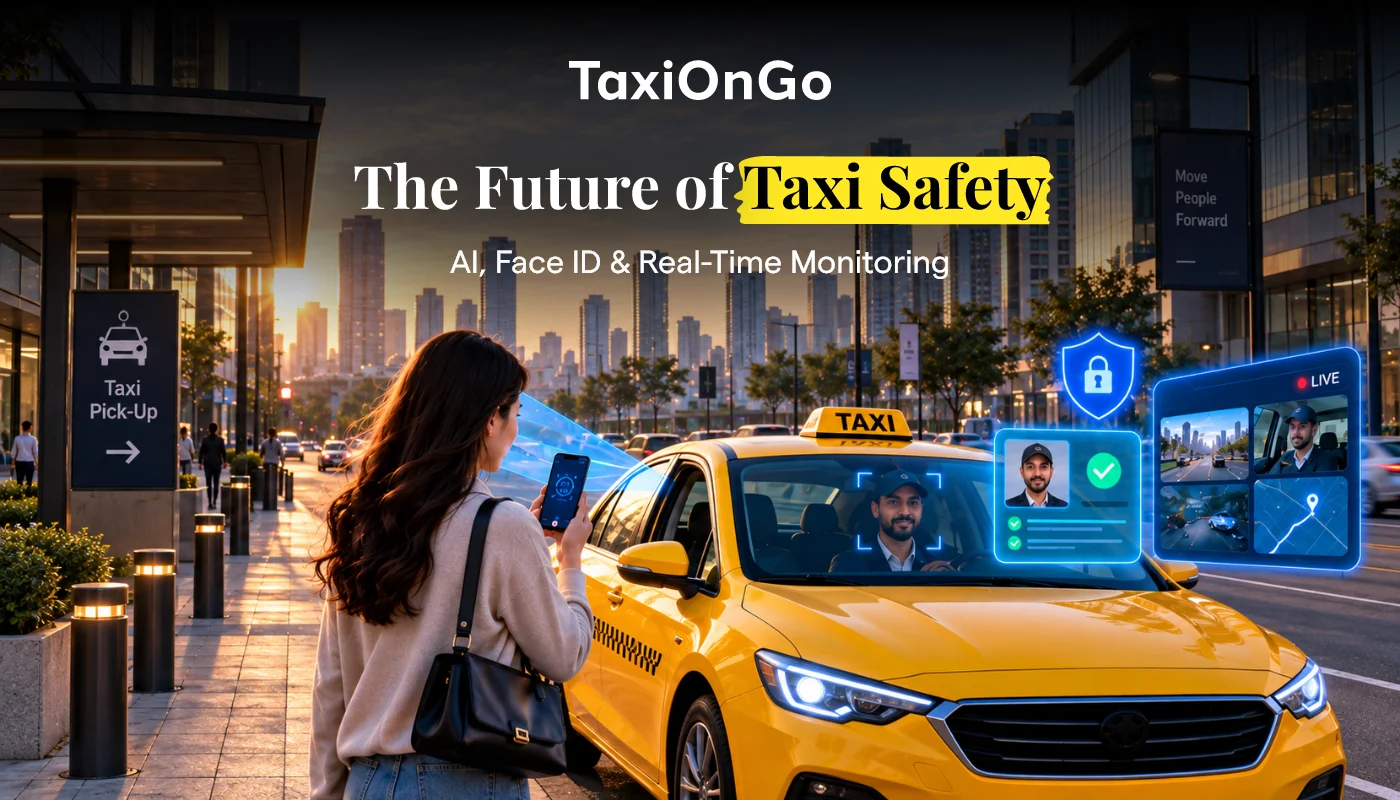
Safety Tech in Taxi Apps: Face ID, Panic AI, and Live Guardians
Safety in a taxi app is no longer limited to showing a driver’s name, vehicle number, and current location. Modern ride-hailing platforms can combine identity verification, GPS-based ride monitoring, SOS tools, trusted-contact sharing, and AI-assisted anomaly detection to create multiple layers of protection around every trip.
The technology is already moving in this direction. Uber uses real-time photo checks and, in some markets, facial recognition to help verify that the person using a driver account is the registered driver. Its RideCheck technology uses GPS and smartphone sensor data to identify events such as unusually long stops or possible crashes. Lyft also provides real-time ride tracking, ride sharing, and in-app emergency assistance.
For taxi operators, these capabilities are becoming an important consideration when choosing a taxi safety app, developing a custom platform, or upgrading a white label taxi booking app.
The goal is straightforward: identify risks earlier, give riders and drivers faster ways to request assistance, and provide fleet operators with better visibility into active trips.
What Safety Features Should a Taxi App Have?
A taxi app should combine preventive, real-time, and emergency safety features instead of relying on a single SOS button.
Important taxi app safety features can include:
- Driver identity and document verification
- Rider verification
- Real-time GPS tracking
- SOS or panic button
- Trusted-contact trip sharing
- Trip start PIN or OTP verification
- Route-deviation detection
- Unusual-stop or crash detection
- Emergency contact integration
- Driver and passenger ratings
- Masked phone numbers
- Admin alerts and incident management
These features protect users at different points in the ride.
For example, identity verification helps reduce account misuse before a trip starts. PIN verification can help a passenger confirm that they are entering the correct vehicle. During the journey, GPS monitoring can identify unexpected trip behavior. If something goes wrong, an SOS function provides a faster route to assistance.
Uber, for example, offers an optional four-digit PIN that must be given to the matched driver before the trip can begin.
TaxiOnGo already includes several relevant foundations, including SOS, real-time cab tracking, GPS-based vehicle tracking, driver ID and vehicle-document submission, and real-time ride-detail sharing with contacts.
How Do Taxi Apps Verify Driver Identity?
Taxi apps can verify drivers using a combination of identity documents, profile information, selfies, liveness checks, and account verification controls.
The process can begin during driver onboarding. A driver submits required identification and vehicle documentation, which is reviewed before the account is approved. Additional checks can then be performed periodically while the driver uses the platform.
A more advanced workflow might ask the driver to take a live selfie before going online or accepting trips. The system can compare that image with the verified profile image associated with the account.
Uber documents this type of process. Its photo-verification system can use liveness detection to establish that the submitted image represents a live person. Depending on the market, it can also use facial recognition to compare images.
This additional verification layer can make unauthorized driver-account sharing harder. For fleet operators, driver verification can therefore become an ongoing safety process rather than a one-time onboarding task.
How Does Facial Recognition Work in Taxi Apps?
Facial recognition in taxi apps can compare a newly captured facial image with an enrolled or verified reference image to determine whether they likely represent the same person.
A typical driver-verification flow could look like this: The driver takes a live selfie, which is checked for liveness and matched with the registered image before account access is approved.
Liveness detection is particularly important because a simple image comparison could otherwise be vulnerable to someone presenting a photograph or another representation of the registered user.
Uber states that its live-photo process can use liveness detection, while facial verification may be used in some markets for photo comparisons.
However, facial recognition should not be treated as infallible.
NIST warns that biometric characteristics are not secrets in the same way passwords are. Facial images can potentially be obtained without a person’s consent, and biometric systems introduce privacy and security considerations. NIST recommends protections including presentation-attack detection and treating biometric information as sensitive personal information.
For taxi businesses adding Face ID or facial verification through taxi app development services, privacy, consent, retention policies, security, fallback verification methods, and applicable biometric laws therefore need to be considered during system design.
What Is a Panic Button in a Taxi App?
A panic or SOS button is an in-app emergency control that allows a passenger or driver to request help quickly during a potentially unsafe ride.
Instead of forcing someone to leave the taxi app, find a number, explain their location, and provide vehicle information manually, an integrated emergency workflow can make relevant trip information immediately accessible.
Depending on the implementation and local emergency infrastructure, an SOS workflow may use information such as:
Current GPS location + trip ID + driver details + vehicle details + emergency contact
The exact response mechanism varies by platform and country.
For example, Lyft says its emergency-assistance functionality can connect riders to safety support and, in supported implementations, provide real-time location and vehicle information to emergency responders.
TaxiOnGo also lists SOS as one of the features available in its taxi platform.
The key design principle is accessibility. An emergency feature buried under multiple menus provides much less value when seconds matter.
How Does AI Improve Passenger Safety in Ride-Hailing Apps?
AI can improve passenger safety by helping a taxi platform identify unusual trip patterns that may require attention.
A conventional fleet tracking system tells an operator where a vehicle is. An AI-assisted monitoring system can potentially analyze what is happening during that journey.
Depending on the data available and how the system is designed, safety logic can flag patterns such as:
- Unexpectedly long stops
- Significant route deviations
- Possible vehicle crashes
- Abnormal trip duration
- Unexpected trip termination
- Other predefined high-risk anomalies
The system can then initiate an appropriate workflow, such as asking the rider or driver whether everything is okay or escalating the event according to the operator’s safety protocol.
This is not hypothetical as a general approach. Uber’s RideCheck uses GPS data and smartphone sensors to detect certain trip irregularities, including long stops and possible crashes.
This is where the idea of AI-powered taxi safety becomes valuable. AI does not replace emergency services or human safety teams. Its role is to help identify signals faster and initiate the appropriate response process.
What Are Live Guardians in a Taxi Safety App?
A “live guardian” can be understood as a trusted person or safety service that can follow an active journey and respond when necessary. The underlying functionality, however, already exists in major ride-hailing platforms.
Lyft allows riders to share ride information with friends and family, including pickup and drop-off points, approximate GPS location, driver information, vehicle information, and license plate number.
TaxiOnGo passengers can share ride details with contacts so those contacts can know their whereabouts in real time and track the route taken during the journey.
For taxi operators, this concept could be expanded through configurable safety workflows that connect live trip information, emergency contacts, monitoring systems, and support teams.
How Do Taxi Apps Handle Passenger Emergencies?
A well-designed taxi app should handle an emergency through a structured escalation workflow rather than relying on a single notification.
A possible workflow is:
When a passenger triggers SOS, the app captures trip and location details, alerts designated contacts or safety personnel, initiates available emergency assistance, and records the incident for follow-up.
AI-assisted systems can add another layer by initiating a safety check even when the passenger has not manually pressed an emergency button.
For example, if a vehicle stops unexpectedly for an unusual period, the platform could ask the passenger and driver whether assistance is required.
Major platforms already demonstrate elements of this approach. Lyft provides emergency assistance and real-time tracking tools, while Uber’s RideCheck can detect selected trip irregularities.
For independent taxi businesses, integrating similar workflows into their own branded platform can help move safety management from reactive incident reporting toward real-time intervention.
Why Real-Time Taxi Ride Monitoring Matters
A taxi company cannot effectively respond to an active trip if it has little visibility into where its vehicles are. That makes real-time taxi ride monitoring an important foundation for both fleet management and safety.
With GPS-based monitoring, an operator can see active vehicle locations and ongoing trips. When this information is connected with route data and safety rules, the platform can also support exception-based monitoring.
Instead of watching every vehicle manually, dispatchers can focus attention on trips that have been flagged for unusual activity.
TaxiOnGo’s admin platform provides trip/cab tracking that allows administrators to monitor ongoing trips and vehicle locations. Its GPS vehicle tracking also makes drivers traceable within the fleet-management environment.
This creates the technical foundation upon which more sophisticated safety workflows can be developed.
Building Safety Into a White Label Taxi Booking App
Independent taxi businesses do not necessarily need to develop an entire ride-hailing ecosystem from zero to introduce digital safety capabilities.
A white label taxi booking app provides an existing rider, driver, and administration platform that can be customized for a taxi company’s brand and operational requirements.
TaxiOnGo, for example, provides native iOS and Android apps, a web-based administration system, GPS tracking, trip tracking, driver-document management, SOS functionality, and ride sharing. Its platform is a customizable white-label solution for taxi operators.
Advanced capabilities such as facial verification, automated anomaly detection, or specialized emergency integrations should be evaluated separately based on the operator’s requirements.
Safety Should Work Before, During, and After Every Ride
The strongest taxi safety strategy is not one feature. It is a connected system. Before the ride, verification can help establish who is using the platform.
During the ride, GPS tracking, trusted-contact sharing, route monitoring, and anomaly detection can improve visibility. When something goes wrong, SOS and emergency workflows can make assistance easier to access.
Afterward, incident records, ratings, and administrative controls can help operators investigate issues and improve their processes.
For taxi companies building or modernizing their digital platforms, this means safety should be part of the product architecture rather than an add-on added after launch.
TaxiOnGo provides a customizable white-label taxi booking platform with existing capabilities including SOS, real-time tracking, ride sharing, driver-document management, and fleet administration. Operators can then evaluate additional safety requirements according to their market, regulations, and operating model.
Frequently Asked Question
Taxi companies can combine verified rider and driver accounts, GPS tracking, trip sharing, SOS functionality, route monitoring, masked communication, incident reporting, and clear emergency procedures. Lyft, for example, provides drivers with emergency assistance and real-time location-sharing tools.
Passenger verification can use phone or account verification, identity databases, government-issued identification, selfies, and, where legally permitted, facial verification. Uber says its rider-verification process can cross-check account information and may request government ID and a selfie when additional verification is necessary.
Real-time ride monitoring typically uses GPS location and trip information to track a vehicle throughout an active journey. More advanced systems can analyze this data for unusual events such as unexpected stops or potential crashes and initiate safety checks.
Facial recognition can strengthen identity verification when appropriately implemented, but it carries security and privacy risks. NIST states that biometric data should be treated as sensitive personal information and recommends safeguards around its collection, authentication, protection, and use.
Useful security features include driver and rider verification, SOS assistance, real-time GPS tracking, trusted-contact ride sharing, trip PINs, route-anomaly detection, masked communication, secure payments, and administrative incident management. The appropriate combination depends on the operator, region, and applicable regulations.
There is no defensible universal price for adding AI safety features without defining the feature scope. Costs vary substantially depending on whether the requirement involves third-party facial verification, liveness detection, GPS anomaly detection, emergency-service integrations, cloud processing, admin workflows, or custom AI models. A technical assessment is required before providing a reliable estimate.
Recent Blogs
A taxi booking app can earn revenue through ride commissions, driver subscriptions, booking fees, dynamic pricing, advertising, corporate transport contracts and additional mobility services. The right model depends on who owns the vehicles, how drivers are engaged, local transport regulations and the number of completed bookings. Some platforms use one primary revenue stream, while others […] Read more
Taxi businesses can lose a significant portion of potential revenue when they rely on manual booking methods instead of digital booking systems. Missed calls, delayed dispatching, inefficient fleet utilization, and poor customer experiences often result in lost bookings and lower driver productivity. A modern taxi booking app helps eliminate these inefficiencies by automating ride requests, […] Read more

Fleet businesses planning to digitize their operations face an important decision- should they build custom taxi software from scratch or purchase a ready-made platform? Building offers greater control over the product, technology and user experience. Buying white label taxi software, however, usually provides faster deployment, a lower initial investment and access to essential features that […] Read more